Conditions · Hair · Pattern Loss

Androgenetic Alopecia (Pattern Hair Loss)

Medically reviewed by Dr Sin Yong · Last reviewed · 10 min read · Assessed personally by Dr Sin Yong · Jump to questions

Androgenetic alopecia is the diagnosis behind most thinning heads: genetically sensitive follicles responding to normal androgen levels by miniaturising — each growth cycle producing a finer, shorter, paler hair than the last, until the follicle retires. It runs on a timetable written in your genes, it is progressive by default, and it is a well-evidenced treatable form of hair loss in medicine.

WhatsApp Dr Sin Yong →
Invited by Device Makers to Share His Expertise
International KOL for 14+ device brandsShared his clinical expertise with 500+ doctors across AsiaMBBS (NUS) · MRCS (Edinburgh) · MSc with Distinction (Queen Mary, London) · MSc (Cardiff)Every assessment personally by Dr Sin Yong

Androgenetic alopecia is hereditary pattern hair loss: genetically sensitive follicles respond to normal levels of dihydrotestosterone (DHT) by miniaturising, producing finer, shorter hairs with each cycle. Men typically thin at the temples and crown, women along the central parting. Assessment stages the pattern and the degree of miniaturisation, because treatment works on surviving follicles, not bare scalp.

Also called: pattern hair loss, androgenetic alopecia, 脱发, 雄激素性脱发, AGA

In brief
  • Androgenetic alopecia is hereditary pattern hair loss: genetically sensitive follicles respond to normal DHT levels by miniaturising.
  • Men typically thin at the temples and crown; women along the central parting with the frontal hairline preserved.
  • Treatment acts on surviving follicles, so bare, shiny scalp largely does not respond and timing matters.
Key takeaways
  • Androgenetic alopecia is hereditary pattern hair loss: genetically sensitive follicles respond to normal DHT levels by miniaturising.
  • Men typically thin at the temples and crown; women along the central parting with the frontal hairline preserved.
  • Diagnosis rests on pattern and timeline, separating it from telogen effluvium, alopecia areata, traction and scalp inflammation.
  • Guideline treatment is long-term: topical minoxidil, and oral finasteride for men, with in-clinic options layered around it.
  • Treatment acts on surviving follicles; bare, shiny scalp largely does not respond, so timing matters.

Key Facts

The mechanism
Dihydrotestosterone (DHT) acting on genetically sensitive follicles → progressive miniaturisation
The male pattern
Norwood stages: temples and crown first, the classic M-shape and vertex thinning
The female pattern
Ludwig stages: diffuse widening of the central parting with a preserved frontal hairline
The key insight
Hormone levels are usually normal — sensitivity, not excess, drives the loss
Guideline treatments
Topical minoxidil and (in men) oral finasteride anchor the evidence-based S3 guideline ladder
The timing truth
Every treatment defends and thickens surviving follicles best — miniaturisation is reversible, bare scalp largely is not
Who assesses this
A physician — pattern mapping and miniaturisation staging
Typical first step
Start while follicles survive; treatment defends what still exists

What does androgenetic alopecia look like?
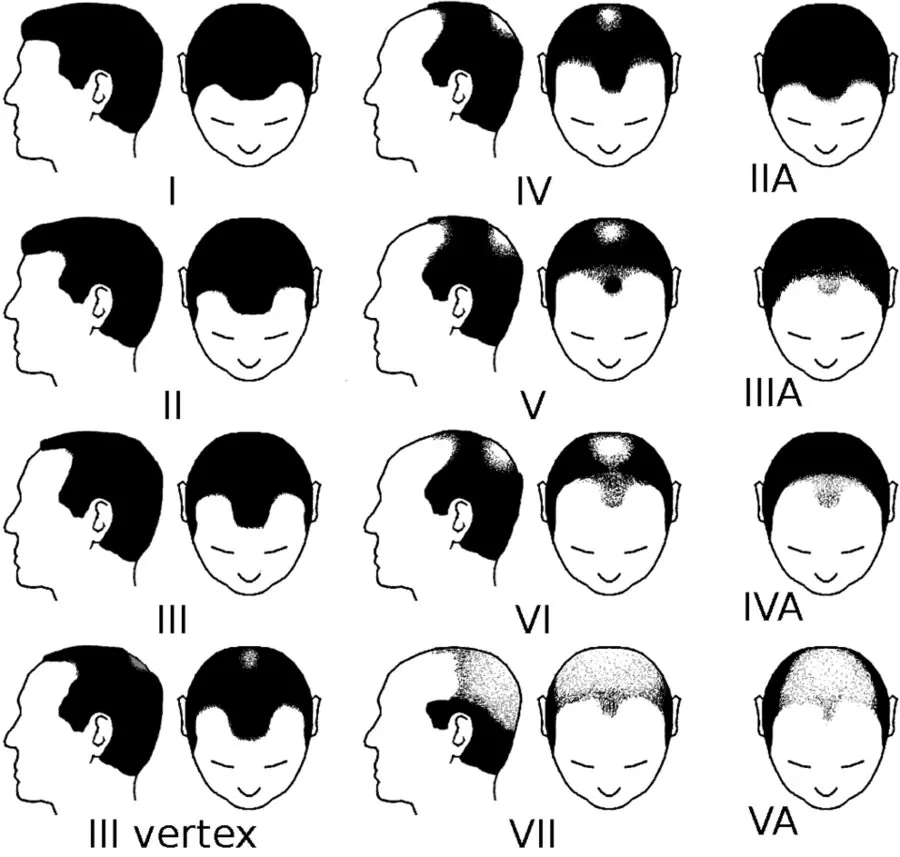
The Hamilton–Norwood scale — the standard staging of male pattern hair loss
The Hamilton–Norwood scale — the standard staging of male pattern hair loss. Image: Keministi, via Wikimedia Commons (CC0).
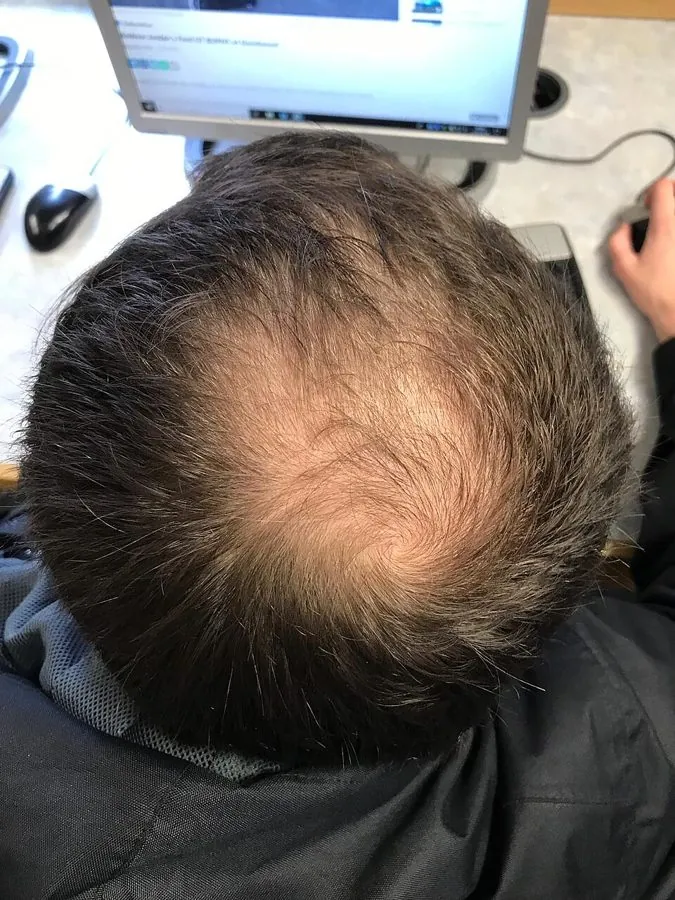
Early crown thinning seen from above
Early crown thinning seen from above. Image: BlaiserPascal, via Wikimedia Commons (CC BY-SA 4.0).
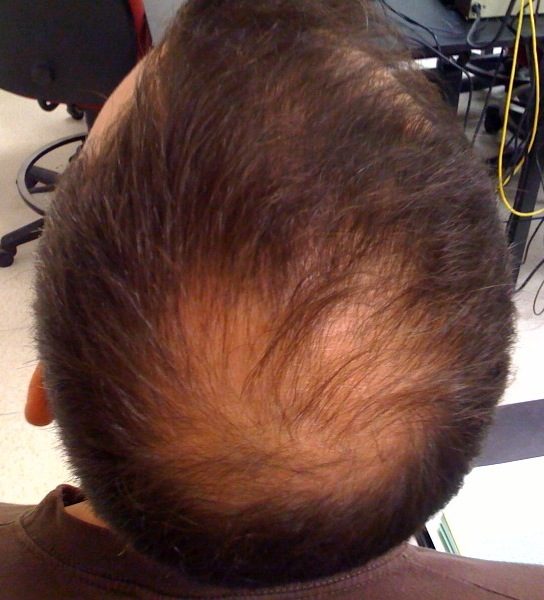
Advanced vertex hair loss
Advanced vertex hair loss. Image: Welshsk, via Wikimedia Commons (CC BY 3.0).

How does pattern hair loss actually happen?

Follicles in the pattern zones — temples and crown in men, the central scalp in women — carry inherited sensitivity to dihydrotestosterone. Under DHT's influence each hair cycle shortens and each regrown hair miniaturises: finer calibre, shorter length, less pigment, until terminal hairs have become barely-visible vellus fuzz and, eventually, the follicle falls dormant [1]. Two clarifications the internet muddles: hormone levels are usually normal — sensitivity is the inheritance, which is why blood tests are often unremarkable — and the pattern's shape is the diagnosis's signature, distinct in men (receding temples and crown) and women (a widening parting behind an intact hairline).

Pattern loss or something else?

The pattern and the timeline separate AGA from its neighbours. Gradual thinning in the classic zones over years is AGA. Diffuse shedding in handfuls after illness, childbirth or crash dieting is telogen effluvium — a different, usually self-limiting process. Coin-shaped bare patches with sharp edges are alopecia areata, an autoimmune event. A receding edge tracking years of tight hairstyles is traction. And a flaky, inflamed scalp thins hair by its own route — see seborrhoeic dermatitis. The conditions coexist happily, and a shedding episode often unmasks underlying AGA — which is why diagnosis precedes every plan here.

What actually works for pattern hair loss?

AGA holds the strongest treatment evidence in hair medicine, codified in the European S3 guideline [1]: topical minoxidil for men and women, oral finasteride for men — both slowing loss and partially reversing miniaturisation in trial after trial — with the guideline framing treatment as long-term, since benefit persists only while treatment continues. Around that pharmacological spine, Dr Sin Yong's programmes layer the clinic arm: medication management, H2LT laser hyperstimulation, Regenera Activa micrograft therapy, and the assessment-led pathways of the male and female hair loss programmes — with restoration planning for advanced zones. The single most consequential variable is the calendar: treatment defends follicles that still exist. Miniaturised is recoverable; bare and shiny mostly is not.

What doesn't work for pattern hair loss?

Waiting a few more years 'to see how bad it gets' — the answer arrives with fewer follicles to save. Caffeine shampoos and biotin as a strategy — supermarket adjuncts against a hormonal mechanism. Scalp massage rituals — circulation was never the problem. Stopping effective treatment once things improve — AGA resumes its timetable within months of the last dose. And for women, assuming nothing can be done because finasteride headlines are male — the female pathway has its own evidence-backed ladder, which is what the assessment maps.

“Pattern hair loss treatment defends the hairs you still have — which is why the best year to start is always the year you first wondered.”

— Dr Sin Yong

Dr Sin Yong’s Viewpoint

Pattern loss is a well-evidenced treatable condition in hair medicine, and the variable that matters most is the calendar. Treatment defends follicles that still exist — the best year to start is the year you first wondered. I would rather have the early consult that seems premature than the late one that is.

Prefer Not to Use WhatsApp?

Use the short enquiry form instead →

Leave your name, mobile number and email and the clinic will contact you directly. No obligation.

Your details are delivered directly to Dr Sin Yong's clinic team.

Thank you — your enquiry has been received. The clinic will contact you during opening hours (Mon–Fri 10am–8pm, Sat 11am–3pm).

Prefer a preliminary view first? You can also WhatsApp a photo of the area for Dr Sin Yong to review before you decide on a visit.

Which type do you have?

Pattern hair loss and its look-alikes
Type / look-alikeHow to recognise itWhat it needsWhat does not work
Male pattern loss (Norwood stages)Receding temples and crown thinning, the classic M-shape and vertexStaging, then long-term medical treatment and clinic optionsWaiting years to see how bad it gets
Female pattern loss (Ludwig stages)Widening central parting with a preserved frontal hairlineStaging and a female-specific, evidence-backed pathwayAssuming nothing can be done because finasteride headlines are male
Telogen effluvium (diffuse shedding)Diffuse shedding in handfuls after illness, childbirth or crash dietingFinding the trigger; usually self-limitingTreating it as pattern loss alone
Alopecia areata (autoimmune patches)Coin-shaped bare patches with sharp edgesDiagnosis and autoimmune-directed carePattern-loss medication as the sole plan
Traction alopecia (tight hairstyles)Receding edge tracking years of tight hairstylesStopping the traction early, then reviewContinuing the hairstyle while treating the scalp

What does not work, and why

When to see a doctor

Myths we hear in clinic

“Pattern hair loss means your hormone levels are abnormal.”

Levels are usually normal; inherited follicle sensitivity to DHT, not excess hormone, drives the loss.

“Caffeine shampoo, biotin or scalp massage can treat pattern hair loss.”

They do not address the hormonal mechanism; guideline treatment is medical and long-term.

Questions Patients Actually Ask

Is androgenetic alopecia only a male condition?+

No — female pattern hair loss is the same follicular biology in a different distribution: a widening parting rather than receding temples. It affects a large share of women, rising after menopause.

My hormones tested normal — how can it be hormonal?+

Because the mechanism is follicle sensitivity to normal DHT levels, not hormonal excess. Normal blood work is the typical AGA finding, not evidence against it.

Does minoxidil work?+

It carries guideline-level evidence in men and women — slowing loss and thickening miniaturised hairs — with effect maintained only during continued use, and an early temporary shed as cycles resynchronise.

Is finasteride safe?+

It is a prescription medicine with a defined, extensively studied profile in men — the risk-benefit conversation is individual and belongs with a physician, which is exactly how it is prescribed here. It is not used in women of childbearing potential.

Can lost hair come back?+

Miniaturised, still-cycling follicles can recover calibre with treatment. Zones bare and shiny for years hold few salvageable follicles — the honest boundary between medical treatment and restoration planning.

How fast does treatment show results?+

Hair answers in cycles, not weeks: expect several months before change is visible and about a year for a fair verdict — with photographs, not memory, keeping score.

What causes androgenetic alopecia?+
Follicles in the pattern zones carry an inherited sensitivity to dihydrotestosterone. Under its influence each hair cycle shortens and each regrown hair is finer and shorter, until the follicle falls dormant. Hormone levels are usually normal, because sensitivity rather than excess drives the loss, which is why blood tests are often unremarkable.
Can androgenetic alopecia be cured?+
There is no cure that can be promised. Treatment is long-term: it slows loss and can partly reverse miniaturisation in follicles that survive, but benefit lasts while treatment continues. Bare, shiny scalp largely does not respond, which is why assessment early, while follicles are still miniaturised rather than gone, matters most.
Which treatment suits androgenetic alopecia?+
It depends on sex, stage and the degree of miniaturisation. The guideline foundation is topical minoxidil for men and women and oral finasteride for men, with in-clinic options such as laser stimulation or micrograft therapy layered around it. Decision factors include donor quality, tolerance for medication, pregnancy plans and how advanced the zones are.
How much does androgenetic alopecia treatment cost in Singapore?+
Cost follows the plan. It depends on your stage and sex, the areas involved, whether medication management is used alone or with in-clinic options, the consumables involved, and how treatment is staged over time. A written quote is given at consultation, after pattern mapping, and the consultation decides whether treatment is advised at all.

References

  1. Evidence-Based (S3) Guideline for the Treatment of Androgenetic Alopecia in Women and in Men — Journal of the German Society of Dermatology (PubMed).
  2. Androgenetic Alopecia (Male and Female Pattern Hair Loss) — DermNet NZ.

Medically reviewed by Dr Sin Yong, MBBS (NUS), MRCS (Edinburgh) · Last updated 7 September 2026 · Editorial policy

Follow Dr Sin Yong
InstagramTikTokYouTubeThreadsXLinkedInFacebook
Printable patient guide (PDF): Hair loss: what to check first — medically reviewed by Dr Sin Yong.
Dr Sin Yong · Every assessment personally performed
WhatsApp Enquiry