Medically reviewed by Dr Sin Yong · Last reviewed · 26 min read · Doctor-performed, never delegated · Jump to questions
Dr Sin Yong · MBBS (NUS) · MRCS (Edin) · MSc Aesthetic Medicine with Distinction (Queen Mary, London) · MSc Practical Dermatology (Cardiff) · International KOL
Two wavelengths, not one. A long-pulsed 755 nm alexandrite and 1064 nm Nd:YAG on the same platform — which is what allows treatment to be matched to skin type rather than the other way round.
Laser hair removal in Singapore uses laser energy absorbed by melanin in the hair to heat the follicle and reduce regrowth. Because skin pigment competes for the same energy, the wavelength has to match the skin: 755 nm alexandrite for lighter skin, 1064 nm Nd:YAG for darker skin. Treatment is staged, doctor-supervised and planned after assessment.
Also called: medical laser hair removal, 激光脱毛, 医療レーザー脱毛
Key takeaways
Laser hair removal uses laser energy absorbed by melanin in the hair to heat the follicle and reduce regrowth.
The wavelength must match the skin: 755 nm alexandrite for lighter skin, 1064 nm Nd:YAG for darker skin.
White, grey or very fine hair carries little melanin and responds poorly, whatever the device.
Treatment is staged across visits, because follicles respond mainly in the active growth phase.
Every session is doctor-supervised, with settings determined by Dr Sin Yong after examining skin and hair.
The principle is selective photothermolysis. Melanin in the hair shaft absorbs laser energy, that energy converts to heat, and the heat conducts to the follicular structures responsible for producing the hair.
Two things follow from this. First, the target is pigment — so hair that carries little melanin responds poorly regardless of the device. Second, the melanin in your skin competes for the same energy, which is where skin type becomes the governing variable.
Hair also grows in cycles, and only follicles in the active anagen phase are susceptible at any given moment. This is why treatment is staged rather than done once.
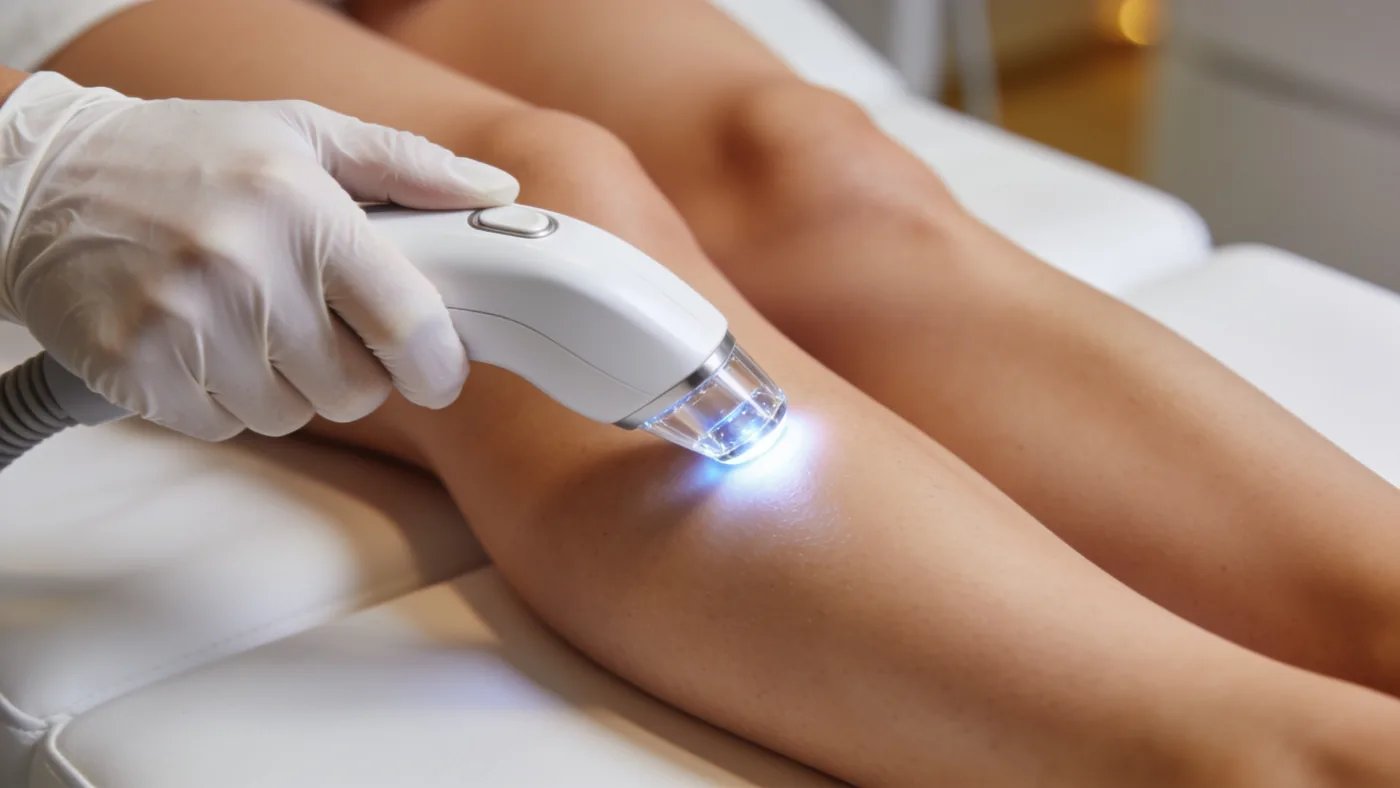
Illustrative. The cooled tip protects the surface while the energy is delivered to the follicle beneath it.
Why the Wavelength Has to Match the Skin
This is the part most often glossed over, and it is the whole reason a dual-wavelength platform exists.
755 nm alexandrite is strongly absorbed by melanin. Where there is good contrast between dark hair and lighter skin — Fitzpatrick I to III — that strong absorption is precisely what you want. But the same property becomes a liability as skin pigment increases: surface melanin absorbs energy intended for the follicle.
1064 nm Nd:YAG behaves differently. The longer wavelength is less readily absorbed by melanin in the upper layers and penetrates deeper, so more energy reaches the follicle rather than being taken up on the way through. This is what makes it the appropriate wavelength for Fitzpatrick IV to VI.
Neither wavelength is better. They answer different skin. Having both on one platform means the treatment is matched to you, rather than you being told your skin type is unsuitable.
Illustrative. The same hair on three different skin types calls for different wavelengths and settings, not one protocol.
What This Means in Singapore
Singapore's population spans a wide phototype range, and a great deal of it sits in Fitzpatrick III to V — exactly the range where wavelength choice stops being academic.
Treatment on darker skin with an inappropriate wavelength or setting risks epidermal injury and post-inflammatory pigment change. Getting this right is a matter of assessment and parameter selection, not of buying a machine.
The same platform underpins Dr Sin Yong's R2 Glow protocol, where long-pulsed delivery is directed at inflammatory activity in the skin rather than at the hair follicle.
Areas Treated
Areas are planned together where that makes sense — a brazilian, underarms and legs are commonly assessed in the same consultation — but each is set independently, because the skin and the hair differ from one area to the next.
Brazilian & bikiniCoarse, dark hair on skin that is often a shade deeper than the face — wavelength and cooling matter most here.
UnderarmsOne of the commonest requests, often together with pigment and sweat in the same area.
Full legsThe largest area and the one most often started abroad; previous treatment is taken into account when settings are chosen.
ArmsFiner hair in many patients, where the alexandrite wavelength is often the better match on lighter skin.
Upper lip & chinFine or hormonal hair close to the mouth, assessed for cause as well as treated.
Back, chest & beard lineDense terminal hair and, in men, the ingrown-hair pattern that comes with shaving.
Finer or lighter hair, and patients who started treatment elsewhere
Many of the patients who ask about hair removal here grew up in a different climate and a different clinic system — Japanese, Australian and European patients in particular — and two things tend to be true of them. Their hair is often finer and lighter than the coarse dark hair most Singapore protocols are set for, and they have frequently had IPL or diode treatment abroad that stopped short of the result they wanted.
Finer, lighter hair on lighter skin is where the 755 nm alexandrite wavelength earns its place: its strong absorption by melanin is what makes it effective on hair that carries less of it. Darker or recently tanned skin moves the decision toward 1064 nm Nd:YAG. Neither is a default; the choice is made area by area at assessment, and previous treatment elsewhere is taken into account when settings are chosen.
Every session is doctor-supervised. Settings are determined by Dr Sin Yong after examining the skin and the hair in each area rather than taken from a fixed protocol, and the consultation is conducted in English with time for questions.
Key Facts
At a glance
Platform
R2 Glow — long-pulsed dual-wavelength laser
Wavelengths
755 nm alexandrite and 1064 nm Nd:YAG
Mechanism
Selective photothermolysis — melanin in the hair shaft absorbs the energy, which conducts to the follicular structures
755 nm alexandrite
Strongly absorbed by melanin. Suited to Fitzpatrick I–III, where contrast between dark hair and lighter skin is high
1064 nm Nd:YAG
Longer wavelength, less absorbed by surface melanin, penetrates deeper. The wavelength of choice for Fitzpatrick IV–VI
Why two matters
A single-wavelength device forces a compromise on one end of the skin-type range. Two wavelengths remove that compromise
Cooling
Epidermal cooling protects the surface while energy reaches the follicle
Areas
Brazilian and bikini, underarms, legs, arms, upper lip and chin, back, chest and beard line — planned together, set independently
Finer or lighter hair
On lighter skin types the 755 nm alexandrite is usually the better match; previous IPL or diode treatment elsewhere is taken into account
Doctor-led
Every session is doctor-supervised; assessment and settings determined by Dr Sin Yong, not by a fixed protocol
“A single-wavelength device forces you to compromise at one end of the skin-type range. Two wavelengths remove that compromise.”
Dr Sin YongOn dual-wavelength hair removal
What Determines the Cost
Treatment is planned individually, so the cost follows the plan rather than a fixed list. Four things shape it:
Factors discussed at consultation
The area treated. A single zone differs from several, and surface area drives the work involved.
What the assessment finds. The same complaint can have different causes, and the cause decides the approach.
Whether one modality or several. Some presentations are addressed by a single approach; others are not.
How the plan is staged. Work spread over time is planned differently from work done in one visit.
A figure quoted before assessment would not reflect your presentation. Cost is set out clearly at consultation, before anything is agreed.
IPL, SHR and diode — three different things sold under one name
IPL hair removal is not laser. Intense pulsed light emits a broad spectrum, typically 500–1200 nm, scattered across many wavelengths at once; a diode laser emits a single wavelength, usually 755, 808 or 810 nm, matched to melanin in the follicle. Because IPL spreads its energy across wavelengths that the surrounding skin also absorbs, the margin between treating the follicle and heating the epidermis is narrower — and that margin is exactly what matters in Fitzpatrick III–V skin, which predominates in Singapore.
“IPL is not a laser. On darker skin that difference is not academic — it is the whole safety margin.”
Dr Sin YongOn device selection
SHR hair removal describes a delivery method rather than a device class: super hair removal applies lower fluence in rapid repeated passes with in-motion technique, raising bulk temperature gradually instead of delivering one high-energy pulse. It can be run on diode platforms and on some IPL systems, which is why “SHR” alone says little about what is actually being used on you.
So IPL hair removal Singapore and diode laser hair removal Singapore are not competing names for the same service. The question to ask is which wavelength, at what fluence, and matched to which skin phototype — not which acronym appears on the price list.
How long does laser hair removal last?
Laser hair removal reduces regrowth; it does not remove every hair for good. Regulators describe what lasers achieve as a long-term, stable reduction in the number of hairs that regrow after a course of treatment, which is a reduction rather than an absence. Follicles heated sufficiently during their growth phase lose much of their capacity to produce a hair. Follicles that were resting at the time, or that received too little energy, may go on producing one.
Illustrative image — not a patient.
Hair that does return may be finer and lighter, which is part of why later treatments in a course behave differently from early ones. Hormones matter too: androgen-driven areas such as the chin and jawline in some women, and changes around pregnancy or with polycystic ovary syndrome, can bring new growth over time. That is not a failure of earlier treatment, and it is why occasional maintenance is discussed honestly at assessment rather than ruled out.
Whether a particular area is likely to respond well depends on hair colour, hair thickness and skin type, and that is said plainly at consultation rather than discovered afterwards.
Brazilian and underarm laser hair removal: why these areas are set differently
Brazilian and underarm laser hair removal are planned with particular care because the skin in both areas is usually darker than elsewhere on the body, while the hair is coarse, dark and dense. Both features concentrate energy: plenty of pigment in the hair, and more pigment than expected in the skin around it.
In practice this often moves the choice toward 1064 nm Nd:YAG, or toward more conservative 755 nm settings on lighter skin, with close attention to cooling. Friction from clothing, shaving rash and the after-effects of waxing are also commoner in these areas, and inflamed or broken skin is treated only once it has settled.
For a brazilian, the extent of the area, whether the bikini line alone or the full area, is agreed beforehand, and the skin is examined in each part because tone varies within it. Underarm skin is checked for irritation from deodorant or shaving. Men asking about the equivalent area, sometimes called a boyzilian, are assessed on the same principles: skin tone and hair characteristics decide the wavelength, not the name of the area.
How to prepare for laser hair removal, and what aftercare involves
Shave the area beforehand rather than waxing, plucking or using an epilator. The laser needs the hair shaft and its pigment in the follicle; waxing and plucking remove both and leave nothing for the energy to find. Shaving removes only the hair above the surface, which reduces heating of the skin while leaving the target in place.
Avoid tanning and deliberate sun exposure before and between treatments, because recently tanned skin carries more melanin and shifts the balance toward epidermal injury. Remove any self-tanning product. Mention new medication, particularly anything photosensitising, and any recent isotretinoin, and say if you are prone to cold sores when the upper lip is being treated.
Afterwards, redness and small raised bumps around the follicles are common and settle on their own. Treated skin is protected from the sun, and hot baths, saunas and vigorous exercise are put off while it is still warm and red. Treated hairs can appear to keep growing for a short while before they shed; that is the hair leaving the follicle, not regrowth.
Illustrative image — not a patient.
Hair removal options compared
Option
What it does
What it cannot do
Typical recovery
Who it tends to suit
755 nm alexandrite laser (long-pulsed)
Strongly absorbed by melanin; heats pigmented hair in the follicle where it contrasts with lighter skin
Cannot target white, grey or very fine vellus hair; strong absorption by skin pigment limits it on darker or tanned skin
Transient redness and swelling around the follicles; sun protection afterwards
Fitzpatrick I to III with dark or medium hair, including finer hair on lighter skin
1064 nm Nd:YAG laser (long-pulsed)
Longer wavelength, less absorbed by surface melanin, penetrating deeper to reach the follicle
Less suited to fine or light hair that carries little pigment; cannot target white or grey hair
Transient redness and follicular swelling; sun protection afterwards
Fitzpatrick IV to VI, recently tanned skin, and naturally darker areas such as the underarm and bikini line
Diode laser (around 808–810 nm)
A single wavelength between alexandrite and Nd:YAG, absorbed by melanin in the follicle
One fixed wavelength, so adjustment across skin types rests on settings alone; cannot target white or grey hair
Transient redness and follicular swelling
A broad range of skin types with careful settings; not part of the dual-wavelength platform used here
IPL (intense pulsed light)
Broad-spectrum light, typically 500–1200 nm, partly absorbed by melanin in the hair
It is not a laser; energy spread across wavelengths the skin also absorbs narrows the safety margin on darker skin
Transient redness; risk of pigment change if settings are too strong for the skin
Lighter skin with dark hair; a different device class from laser
Electrolysis
Destroys individual follicles with an electrical current, regardless of hair colour
Treats one follicle at a time, so large areas are slow; not offered here
Redness and small scabs at the treated follicles
White, grey or blonde hair that no laser can target, in small areas such as the brows or upper lip
Shaving, waxing or epilation
Removes hair at or below the surface
Does not reduce the follicle's capacity to regrow; waxing and plucking also remove the hair a laser needs, so shaving is used during a laser course
None as such, beyond possible irritation, ingrown hairs or folliculitis
Anyone between laser treatments (shaving), or anyone not pursuing laser
How Dr Sin Yong approaches laser hair removal
Laser hair removal here runs on the R2 Glow platform, a long-pulsed laser carrying both 755 nm alexandrite and 1064 nm Nd:YAG. Dr Sin Yong examines the skin and the hair in each area and chooses the wavelength area by area rather than once for the whole body: 755 nm where finer or lighter hair sits on lighter skin, 1064 nm where the skin is darker or recently tanned, and conservative settings with close attention to cooling in naturally darker zones such as the underarm and bikini line.
Areas treated together, such as a brazilian, underarms and legs, are still set independently. Previous IPL or diode treatment elsewhere is taken into account when settings are chosen, patients shave rather than wax beforehand so the hair shaft stays in the follicle, and every session is doctor-supervised rather than run from a fixed protocol.
Laser hair removal by skin type
Skin type (Fitzpatrick)
How skin pigment competes for the energy
Wavelength usually considered
What needs care
I to II (very fair to fair)
Little melanin in the skin, so most of the energy reaches pigmented hair
755 nm alexandrite
Fine or light hair carries little pigment and may respond poorly
III (light brown)
Moderate competition from skin pigment
755 nm at conservative settings, or 1064 nm in naturally darker areas
A recent tan, or darker zones such as the underarm and bikini line, shift the choice
IV (medium brown)
Skin pigment absorbs a meaningful share of shorter wavelengths
1064 nm Nd:YAG
Epidermal cooling and conservative energy to limit pigment change
V to VI (dark brown to deeply pigmented)
Strong competition at shorter wavelengths
1064 nm Nd:YAG
Settings chosen to protect the epidermis; post-inflammatory pigment change is the main risk
Recently tanned skin, any type
A tan adds melanin to the surface layers
Treatment deferred, or 1064 nm considered
Tanning and self-tan are avoided before and between treatments
White, grey or very fine vellus hair
Too little pigment in the hair itself for any wavelength to target
None reliably
Electrolysis is the alternative; it is not offered here
Who should not have laser hair removal?
Laser hair removal is deferred or not offered in several situations, most of them temporary. Recently tanned or sunburnt skin, or skin with self-tan on it, is not treated until it settles, because the extra pigment absorbs energy meant for the follicle. Active infection, a cold sore, inflamed folliculitis, eczema or broken skin in the area is treated first. Pregnancy is a reason to wait, as hair growth often changes afterwards and treatment in pregnancy has not been studied.
Medicines and history matter. Photosensitising drugs and recent isotretinoin are discussed before any pulse is fired. Vitiligo, a keloid tendency and pigment change after previous laser or IPL call for caution or a different plan. Tattoos, cosmetic tattooing and dark moles in the field are avoided. New or rapidly increasing facial or body hair in a woman is assessed for its cause, such as a hormonal condition, before treatment. White, grey or very fine hair is not a risk, but it will not respond. Suitability is decided area by area at consultation.
Is laser hair removal safe? The risks to know
Laser hair removal has a well-described risk profile, and most effects are short-lived: redness, small raised bumps around the follicles, mild swelling and a sunburn-like warmth that settle on their own. Less commonly the skin can blister, crust or burn, and the healed area can turn darker or lighter than the skin around it. A review of published adverse effects found pigment change in up to 19% of patients treated with shorter-wavelength lasers, particularly in darker skin, compared with 2–3% with the 1064 nm Nd:YAG.
Rarer effects include paradoxical hypertrichosis, folliculitis, a flare of cold sores on the upper lip and whitening of hairs. Eye injury is a recognised hazard of any hair-removal laser, which is why protective eyewear is worn throughout and treatment stays outside the orbital rim.
These risks are reduced by matching the wavelength to skin type, epidermal cooling, conservative settings in naturally darker areas, avoiding a tan, and reviewing the skin as treatment progresses.
What recovery looks like after laser hair removal
The sequence below describes phases, not a timetable: how quickly each passes depends on the settings used, the area and the person, and is discussed at consultation.
Immediately afterRedness and small raised bumps around the follicles, with a sunburn-like warmth; a cooling gel or compress eases it.
The first eveningAvoid hot showers, saunas, exercise and friction on the area; a bland moisturiser and loose clothing are enough.
The following daysBumps and redness settle on their own; treated hairs shed gradually, which can look like regrowth. No waxing or plucking.
As the skin settlesAny crusting, blistering or change in skin colour is uncommon and reviewed; sun protection on exposed areas continues throughout.
Follow-upThe next visit is timed to the hair cycle in that area after assessment, and settings are adjusted to how the skin responded.
Who it suits, who should wait, who is referred on
Tends to suit
Hair that carries enough pigment to respond
Skin that is not freshly tanned, so energy reaches the follicle
Wanting a doctor-supervised plan matched to skin type
Areas such as the beard line, where ingrown hairs are a concern, assessed individually
Better to wait
Recently tanned, sunburnt or self-tanned skin
Pregnancy, or active infection, cold sore, folliculitis or eczema in the area
Recent isotretinoin, until discussed
Referred on
New or rapidly increasing hair in a woman: assessed for a hormonal cause first
Dark or changing moles in the field: skin check before any treatment
Who should not have this treatment
Pregnancy (treatment deferred)
Active infection, cold sore, inflamed folliculitis, eczema or broken skin in the area
Photosensitising medicines or recent isotretinoin (discussed before any pulse)
Vitiligo, or pigment change after previous laser or IPL (caution advised)
Tattoos, cosmetic tattooing or dark moles in the treatment field
Recently tanned or sunburnt skin
People with white, grey or very fine hair, or with freshly tanned skin, tend to respond poorly, as laser targets pigment and this is the wrong tool for them.
Before you book
Declare medications, especially photosensitising medicines, and any recent isotretinoin
Avoid tanning and deliberate sun exposure before and between visits, and remove any self-tan
Say if you are pregnant, planning pregnancy or breastfeeding, or prone to cold sores near the upper lip
Shave the area beforehand; do not wax, pluck or use an epilator, and pause retinoids and acids as advised
Bring records of any IPL, diode or laser hair treatment you have had elsewhere
What determines the fee
The fee depends on the area treated, since a small zone differs from a large one and several areas planned together differ from one, and on the wavelength, device and consumables used. It also depends on the number of passes or zones, whether earlier treatment elsewhere changes the plan, and whether areas are combined. A written quote is given at consultation after assessment. The consultation also decides whether treatment is advised at all for your hair and skin.
IPL emits broad-spectrum light, while a laser emits a single wavelength matched to melanin in the follicle.
“Darker skin cannot have laser hair removal.”
The 1064 nm Nd:YAG wavelength is chosen for darker skin after assessment, with settings set for that skin.
Underarm (armpit) laser hair removal in Singapore
The underarm is one of the commonest areas requested, and it behaves differently from most others. Hair there is typically coarse, dark and dense, and the skin is often a shade deeper than the arm beside it, so both the target and the competing pigment are strong. That tends to move the choice toward 1064 nm Nd:YAG, or toward conservative 755 nm settings on lighter skin, with close attention to cooling. The fold also brings friction, sweat and deodorant, so irritated or shaved-raw skin is allowed to settle before any pulse is delivered. Shaving rather than waxing beforehand leaves the hair shaft in the follicle for the laser to find.
Expect warmth and redness with small raised bumps around the follicles afterwards, which settle on their own, and treated hairs that shed over the following days and can look like regrowth. Treatment is staged across visits because only follicles in their growth phase respond at any one time, and the plan is reviewed rather than fixed in advance. Hair removal does not treat underarm darkening, which is assessed as a separate concern (see underarm treatment singapore). Deodorant and shaving routines are reviewed at the visit, since both can irritate skin that is about to be treated.
Brazilian and bikini laser hair removal in Singapore
For a Brazilian or bikini plan, the first decision is the extent of the area. Whether it is the bikini line alone or the full area is agreed before treatment, and the skin is examined in each part because tone varies within it. Hair here is coarse and dark and the skin is often deeper in colour than elsewhere on the body, so wavelength and epidermal cooling matter more than they do on the arms. Previous waxing or shaving rash is allowed to settle first, and inflamed or broken skin is treated only once it has healed. Men asking for the equivalent area are assessed on the same principles, by skin tone and hair characteristics rather than by the name of the area.
Afterwards the area feels warm and looks red, with small bumps around the follicles, and the usual advice is to avoid hot baths, saunas, vigorous exercise and tight, rubbing clothing while it settles. Treated hairs are shed gradually, so waxing and plucking are avoided between visits and shaving is used instead. Visits are staged and timed to the hair cycle in this area, and settings are adjusted to how the skin responded to the last one. Whether the hair here will respond well depends on its colour and thickness and on your skin type, and that is said plainly at consultation.
Leg laser hair removal in Singapore
Legs are the largest area treated, and also the one most often started elsewhere or abroad. That history matters: earlier IPL or diode treatment changes what hair remains, how it responds and which settings are appropriate, so records of previous treatment are worth bringing. Hair and skin tone also differ between thighs, knees and shins, so a leg is not treated as one uniform surface. Each region is set independently, and the choice between 755 nm alexandrite and 1064 nm Nd:YAG follows skin type, with a recent tan on the lower legs shifting the decision toward 1064 nm or toward waiting until the skin settles.
Finer, lighter hair on lighter skin is where 755 nm tends to be the better match, and very fine vellus hair or white and grey hair carries too little pigment for any laser. Because the area is large, a session covers a lot of skin, and the plan is reviewed region by region instead of being fixed in advance. After treatment, redness and small raised bumps around the follicles are common and settle on their own, treated hairs shed gradually, and sun protection on exposed legs continues throughout. Ingrown hairs from shaving are one common reason to ask, and inflamed bumps are settled before treatment.
Face and upper lip laser hair removal in Singapore
Hair on the face and upper lip is often fine, and in some women hormonal, so the first step is to ask why it is there. New or rapidly increasing hair in a woman is assessed for its cause, such as a hormonal condition, before treatment, and androgen-driven areas such as the chin and jawline can bring new growth over time even after treatment. That is not a failure of earlier treatment, which is why occasional maintenance is discussed honestly. The skin around the mouth is thin and sensitive, so settings and cooling are chosen with care and eye protection is worn throughout, with treatment kept outside the orbital rim.
Fine or very light facial hair carries little melanin and may respond poorly, and white or grey hair will not respond at all. On darker skin, the 1064 nm Nd:YAG wavelength is the usual match, although the facial skin tone is judged in its own right. A rare effect called paradoxical hypertrichosis, in which hair growth increases near a treated area, has been reported most often on the face and neck in darker skin types, which is one reason settings are reviewed as treatment progresses. A cold sore history is declared beforehand because treatment on the upper lip can trigger a flare.
Men's beard and back laser hair removal in Singapore
Men most often ask about the beard line, neck, back and chest, and the reason is usually practical. Hair in these areas is coarse and dense, which concentrates energy in the follicle, and shaving can drive ingrown hairs and razor bumps along the beard line and neck. Laser hair reduction is used because fewer, finer regrowing hairs means less shaving, although response varies and inflamed or infected bumps are settled first. Where bumps persist, the cause is examined, since folliculitis and other conditions can look similar. Wavelength and settings follow skin type, as for any other area.
The beard line needs a decision before the first visit, because reducing growth changes how the beard looks, and the aim in a treated area is a reduction in regrowth. The shape of the line is therefore agreed beforehand, and the area to be treated is marked with you. The back and chest are large areas, so treatment is planned zone by zone and reviewed as it goes. Expect warmth, redness and small bumps afterwards, treated hairs that shed gradually and sun protection on exposed skin. Shaving, not waxing, is used between visits so the hair shaft stays in the follicle, and a recent tan or sunburn is a reason to wait.
Shaving, waxing, IPL or laser: which hair removal method does what?
The four methods are often priced and marketed side by side, but they act on different things. Shaving cuts hair at the surface and leaves the follicle untouched. Waxing pulls hair out from below the surface, yet the follicle remains able to grow another. IPL uses broad-spectrum light and is a different device class from laser. Laser uses a single wavelength chosen to be absorbed by melanin, and it aims at the follicle so that regrowth is reduced over a staged course. Laser is not a removal of every hair, and it works on hair that carries pigment, so white, grey and very fine hair respond poorly whatever the method.
Shaving, waxing, IPL and laser compared by action, effect on regrowth and skin-type note
Method
What it does
Effect on regrowth
Skin-type note
Shaving
Cuts hair at the surface
None; hair regrows as normal
Any skin; razor rash and ingrown hairs are common
Waxing
Pulls hair out below the surface
The follicle can still grow a new hair
Any skin; irritation and ingrown hairs can follow
IPL
Broad-spectrum light partly absorbed by melanin
Varies with the device and settings
Narrower safety margin on darker skin, Fitzpatrick III to V
Laser
One wavelength absorbed by melanin in the hair
Aims at long-term reduction over a staged course
755 nm for lighter skin; 1064 nm for darker skin, set at assessment
Laser hair removal for darker skin: 755 nm vs 1064 nm
Darker skin can have laser hair removal, provided the wavelength is matched to it. The reason lies in melanin: skin pigment competes with hair pigment for the same energy. The 755 nm alexandrite wavelength is strongly absorbed by melanin, which suits Fitzpatrick I to III, where dark hair contrasts with lighter skin. As skin pigment increases, surface melanin absorbs more of that energy, so risk of epidermal injury and post-inflammatory pigment change rises. The 1064 nm Nd:YAG wavelength is less readily absorbed by melanin in the upper layers and penetrates deeper, which is why it is the wavelength of choice for Fitzpatrick IV to VI.
Neither wavelength is better in the abstract; they answer different skin, and having both on one platform means the treatment is matched to you. Fitzpatrick III sits between them, so 755 nm at conservative settings or 1064 nm in naturally darker areas such as the underarm and bikini line may be chosen, and a recent tan shifts the decision toward 1064 nm or toward waiting. Singapore's population is largely Fitzpatrick III to V, so this choice is made area by area. Epidermal cooling and conservative energy protect the surface, and 1064 nm is less suited to fine or light hair, which carries little pigment for any wavelength.
What decides the fee for laser hair removal in Singapore
Three things shape the fee more than any other: the area, the density of the hair and the device and wavelength used. Area matters because a small zone such as the upper lip differs from the legs, and several areas planned together differ from one. Hair density and thickness matter because they affect how the plan is set for each region, and dense coarse hair is planned differently from fine hair. The device and wavelength, and the consumables involved, are part of the cost, which is one reason a price list that names only an acronym is hard to compare with a doctor-supervised plan.
Other factors are the number of passes or zones, whether treatment started elsewhere changes the plan and whether areas are combined. Fees are not published on this site. A written quote is given at consultation, after Dr Sin Yong has examined the skin and hair in each area, and the consultation also decides whether treatment is advised at all. White, grey or very fine hair may not suit laser, and it is better to learn that at the consultation than after a course has started. If the assessment finds that another method or no treatment suits you better, that is what will be said, and nothing is agreed before you have heard it.
Frequently Asked Questions
Laser hair removal works by selective photothermolysis. Melanin in the hair shaft absorbs laser energy, which converts to heat and conducts to the follicular structures that produce hair. Because the target is pigment, hair with little melanin responds poorly, and because hair grows in cycles, treatment is staged across sessions.
Yes, provided the wavelength is appropriate. The 1064 nm Nd:YAG wavelength is less readily absorbed by melanin in the upper skin layers and penetrates more deeply, which makes it the appropriate choice for Fitzpatrick IV to VI. Treating darker skin with a wavelength intended for lighter phototypes carries a risk of epidermal injury and post-inflammatory pigment change.
The 755 nm alexandrite wavelength is strongly absorbed by melanin, which suits Fitzpatrick I to III where dark hair contrasts with lighter skin. The 1064 nm Nd:YAG wavelength is less absorbed by surface melanin and penetrates deeper, which suits Fitzpatrick IV to VI. Neither is preferable in the abstract; they are matched to different skin.
The number of laser hair removal sessions varies with the area, hair characteristics and individual growth cycles. Only follicles in the active growth phase respond at any given session, which is why treatment is staged. The plan is set out at consultation after assessment rather than sold as a fixed package.
Commonly treated areas include the underarms, legs, arms, bikini line, back, chest and face. Suitability for each area, and the appropriate wavelength and settings, are assessed in person.
Most patients describe a snapping sensation with each pulse. Epidermal cooling is used to protect the skin surface and improve tolerance. Comfort varies between individuals and between areas, and is managed during the session.
Cost depends on the area treated, its surface area, and how the plan is staged across sessions. Because these differ considerably between patients, a figure quoted before assessment would not be meaningful. Pricing is set out clearly at consultation.
Suitability is assessed in person. Recent sun exposure or tanning, photosensitising medication, active infection or inflammation in the area, certain skin conditions and pregnancy are among the things considered. Not every patient or every presentation is appropriate for treatment.
Generally not; laser hair reduction does not make treated hair coarser. A rare effect called paradoxical hypertrichosis, in which hair growth increases near a treated area, has been reported, most often on the face and neck in darker skin types. Its cause is not fully understood, and it is one reason settings are chosen area by area and reviewed as treatment progresses.
Yes. The beard line, back and chest are among the areas assessed, and male hair there is often coarse and dense, which concentrates energy in the follicle. Shaping of the beard line is agreed before treatment, because the aim in a treated area is lasting reduction. Wavelength and settings follow skin type, as for any other area.
Neither name settles the question. IPL is a broad-spectrum light source, typically 500–1200 nm, and is not a laser. SHR describes a delivery technique, lower fluence in rapid repeated passes, which can run on diode platforms and on some IPL systems. What matters for safety and response is the wavelength, the fluence and how well both are matched to skin type, which is why treatment here uses long-pulsed 755 nm or 1064 nm laser chosen area by area.
Often, provided the wavelength is chosen for the skin. Underarm skin is frequently darker than the surrounding skin, which moves the choice toward 1064 nm Nd:YAG or conservative 755 nm settings, with close attention to cooling. Shaving rash or irritation from deodorant is allowed to settle first. Laser hair reduction does not itself treat underarm pigmentation, which is assessed as a separate concern.
Laser hair reduction is used for ingrown hairs because fewer and finer regrowing hairs means less of the shaving that drives them, which is why the beard line, neck, bikini line and underarms are common reasons to ask. Response varies, and inflamed or infected bumps are settled before treatment. Where bumps persist, the cause is examined, since folliculitis and other conditions can look similar.
The cost of laser hair removal in Singapore depends on the areas treated, the wavelength and device used, the consumables involved, the number of passes or zones, and whether areas are planned together. A written quote is given at consultation, after Dr Sin Yong has assessed your skin and hair. The consultation also decides whether treatment is advised, so no fixed figure is given in advance.
It can be worthwhile for people with pigmented hair who want less regrowth and accept that treatment is staged and the response varies by area. It is less suitable for white, grey or very fine hair, which responds poorly, for freshly tanned skin, or for anyone expecting every hair to be gone after one visit.
How long laser hair removal lasts depends on the area, hair type, skin type, hormones, the settings used and how closely visits follow the hair cycle. Hair can return over time, and no duration is promised. Review timing, and whether further treatment is advisable, is set at consultation after assessment and adjusted as the skin responds.
Disadvantages include a response that varies, treatment staged across visits, and temporary redness, bumps and warmth. Blistering, burns and darker or lighter patches are uncommon, particularly if the wavelength does not match the skin or the skin is tanned. White, grey or very fine hair responds poorly, and some people need a hormonal cause assessed first.
Can finer or lighter hair be treated?+
Often, on lighter skin types, where the 755 nm alexandrite wavelength is strongly absorbed by what melanin the hair does carry. Very fine vellus hair and truly white or grey hair carry too little pigment for any laser to target, and that is said plainly at assessment rather than discovered afterwards.
Is every session supervised by a doctor?+
Yes. Settings for each area are determined by Dr Sin Yong after examining the skin and the hair, and treatment is doctor-supervised rather than run from a fixed protocol.
Can brazilian, underarms and legs be planned together?+
Yes, they are commonly assessed in the same consultation and planned together. Each area is still set independently, because the skin tone and the hair differ from one area to the next.
I had IPL or laser hair removal in another country. Does that matter?+
It helps to know. Previous treatment changes what hair remains, how it responds and what settings are appropriate, and treatment that was stopped short abroad is one of the commonest reasons patients come in. Bring whatever record you have.
Pigmentation Worse After Laser? Why — Pigmentation worse after laser is common in Asian skin. Why rebound happens and what to do next, by Dr Sin Yong. WhatsAp…
Where Dr Sin Yong consults: Wheelock Place, 501 Orchard Road, Singapore 238880 (unit on booking) · Orchard MRT · Mon–Fri 10am–8pm, Sat 11am–3pm · WhatsApp +65 8023 7170 · Getting here · How fees are quoted