Medically reviewed by Dr Sin Yong · Last reviewed · 16 min read · Assessed personally by Dr Sin Yong · Jump to questions
Ultraformer MPT is CLASSYS's current-generation microfocused ultrasound platform — the successor to the Ultraformer III — delivering focused ultrasound in rapid micro-pulses rather than single spot-by-spot shots. Dr Sin Yong is an International Key Opinion Leader for CLASSYS: he is invited to share his clinical experience on this platform internationally, and this page explains it the way he uses it.
WhatsApp Dr Sin Yong →Ultraformer is a HIFU (high-intensity focused ultrasound) platform made by CLASSYS, and Ultraformer MPT is its micro-pulsed generation. It focuses ultrasound energy at set depths, from the dermis to the SMAS, to tighten and lift mild to moderate laxity without incisions. It is separate from the VF Lift – Vertical Facelift, which uses Volnewmer monopolar radiofrequency.

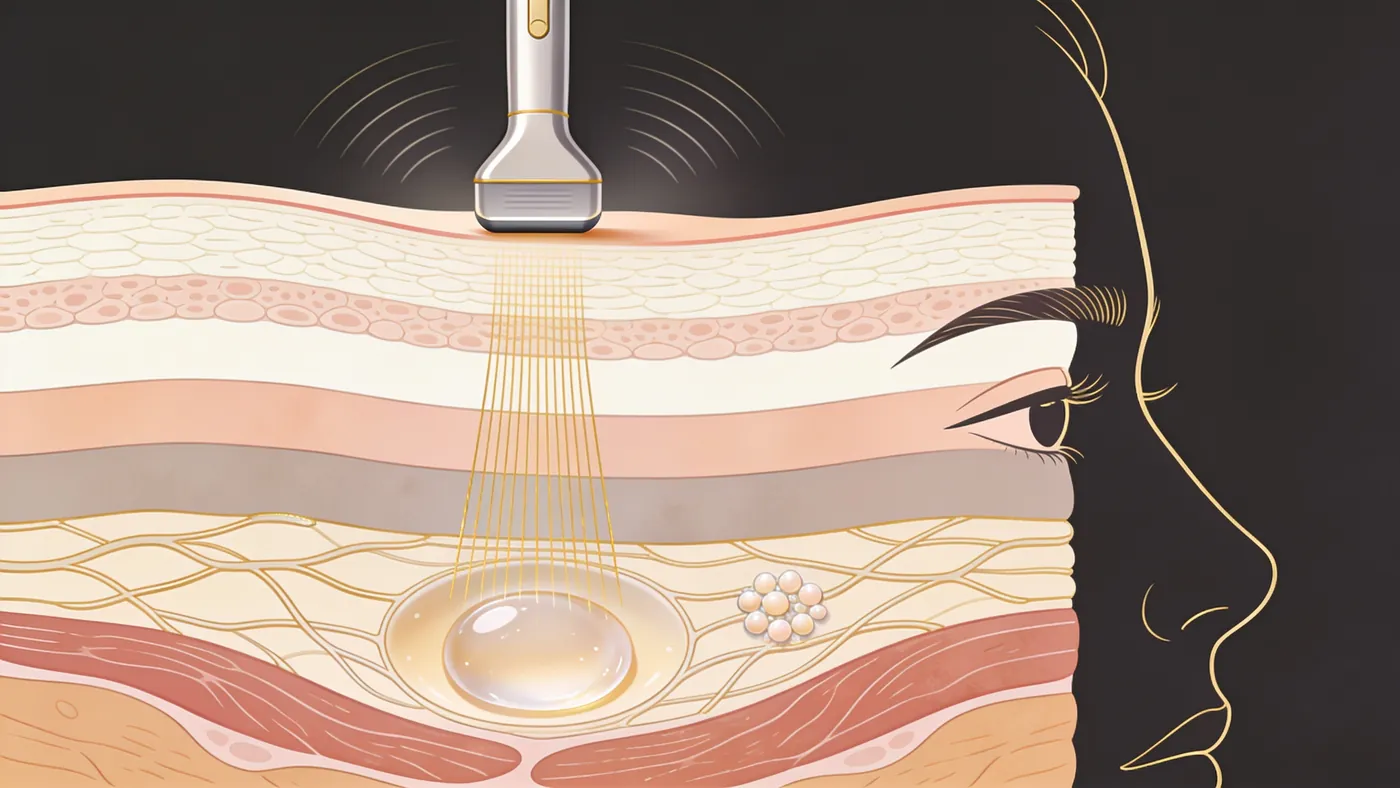
Microfocused ultrasound works like sunlight through a magnifying glass: acoustic energy passes harmlessly through the surface and converges to a point at a chosen depth, where it creates a tiny zone of thermal coagulation. Each point triggers contraction and months of collagen remodelling; thousands of points, placed in lines at the dermis and the SMAS layer, produce the lifting effect documented in the systematic-review literature on MFU [1,2]. MPT — Micro-Pulsed Technology — changes the delivery: instead of firing discrete shots point by point, the transducer glides while emitting rapid micro-pulses, laying energy in a smoother, denser, faster line. In practice that means shorter treatments, more uniform energy distribution, and a comfort profile that patients who remember older shot-based HIFU notice immediately.
Same physics, different engineering generation. The Ultraformer III — long a workhorse in Asian practices — delivers classic spot-by-spot MFU. MPT's continuous micro-pulsed glide changes treatment dynamics: line placement is faster and smoother, and energy per unit area is more evenly distributed, which matters at the comfort-precision frontier. Against the broader HIFU field, the Pan-Asian expert consensus emphasises what actually determines results regardless of badge: correct depth selection for the patient's anatomy, adequate line counts, and operator skill in mapping facial danger zones [2]. The device is the instrument; the assessment and the operator are the treatment.

As a CLASSYS International KOL, Dr Sin Yong uses the Ultraformer platform inside sequenced protocols rather than as a standalone menu item: it is kept separate from the VF Lift (Vertical Facelift), which runs on Volnewmer monopolar radiofrequency and does not use focused ultrasound, and appears across the HIFU programme, sagging face pathway and neck protocols. Candidacy is the honest gate: MFU suits mild-to-moderate laxity — early jowls, softening jawlines, neck laxity — while advanced, heavily mobile laxity is surgical territory that no ultrasound reaches, and the assessment says so plainly [1].
Patients searching for Ultraformer Singapore are rarely comparing like with like. Three generations circulate in this market: Ultraformer III, Ultraformer MPT, and a number of unbranded HIFU devices sold under other names. They share a mechanism — focused ultrasound delivered to a fixed depth — but not a cartridge range, not a pulse-delivery method, and not a service history.
The question worth asking a clinic is not whether they have “Ultraformer”, but which generation, which cartridges, and who is holding the handpiece. A platform is only as good as the depth selected for the tissue in front of it.
HIFU 'facial packages' priced by the shot with no physician mapping — line placement decides both result and safety. Treating advanced laxity with more passes — beyond the indication, more energy is not more lift. Expecting filler-style instant change — MFU's collagen response builds over roughly 8–12 weeks; the day-one change is modest by design. And any clinic that cannot tell you which depths they are treating and why — depth selection is the treatment, and the person guiding it should be able to explain your anatomy back to you.
“The device is the instrument, not the treatment — two clinics with identical Ultraformers can deliver entirely different results, because the lift is in the mapping.”
— Dr Sin Yong
Use the short enquiry form instead →
Leave your name, mobile number and email and the clinic will contact you directly. No obligation.
Prefer a preliminary view first? You can also WhatsApp a photo of the area for Dr Sin Yong to review before you decide on a visit.
| Type / look-alike | How to recognise it | What it needs | What does not work |
|---|---|---|---|
| Early jowls and softening jawline | Mild loss of jawline definition, still firm tissue | Focused ultrasound at suitable depths after assessment | Expecting a surgical-level lift from any ultrasound |
| Neck laxity (mild looseness) | Mild looseness under the chin and along the neck | Neck protocol after examination | Treating the neck without checking the lower face |
| Slim or hollow face | Lean cheeks with early hollowing alongside laxity | Assessment of whether lifting alone suits, or volume support is needed | Tightening without considering volume |
| Heavy, mobile laxity (beyond non-surgical range) | Marked skin excess that moves freely | Referral for a plastic surgery opinion | HIFU or any energy device promising a surgical-level change |
Ultraformer uses focused ultrasound, while the VF Lift – Vertical Facelift uses Volnewmer monopolar radiofrequency and no focused ultrasound.
It suits mild to moderate laxity, and heavy, mobile laxity is surgical territory.
Micro-pulsed delivery spreads energy more evenly than older shot-based HIFU, and most patients describe warmth with brief deep prickles at the SMAS depth — noticeably gentler than the older generation's reputation.
Both are microfocused ultrasound reaching the SMAS. Ultherapy adds live ultrasound visualisation; Ultraformer's approach relies on anatomical mapping and delivers MPT's faster micro-pulsed lines. Platform choice is anatomy- and protocol-dependent — Dr Sin Yong works with both families.
The mechanism is staged: mild immediate contraction, then collagen remodelling building over two to three months. Judging MFU at week one is judging a marathon at the first kilometre.
MPT's continuous delivery makes full-face treatments substantially faster than shot-by-shot HIFU — typically well within a lunchtime window, depending on the mapped plan.
Advanced heavy laxity (surgical territory), significant metal implants in the field, certain skin conditions, and pregnancy are among the exclusions — screening at assessment covers this.
It means the physician invited to share his clinical experience of the platform with other doctors is the one mapping yours — protocol depth, line counts and danger-zone handling are exactly the variables that separate outcomes on identical machines.
Medically reviewed by Dr Sin Yong, MBBS (NUS), MRCS (Edinburgh) · Last updated 7 October 2026 · Editorial policy
Ultraformer and Ultherapy use the same physics, microfocused ultrasound converging to coagulation points at set depths, so the meaningful differences are in engineering and workflow rather than mechanism. Neither is a different kind of treatment from the other.
Ultherapy, made by Merz, adds live ultrasound visualisation: the practitioner can see the tissue layers on screen before energy is delivered. Ultraformer, made by CLASSYS in Korea, relies on anatomical mapping and fixed-depth cartridges, and the MPT generation delivers energy as rapid micro-pulses while the transducer glides, rather than as single shots.
Both reach the SMAS at the deepest setting, and both suit mild to moderate laxity rather than advanced sagging. The published consensus on focused ultrasound places the weight on depth selection for the patient's anatomy, adequate line placement and the operator's handling of facial danger zones, whichever badge is on the device.
In practice, the useful questions are the same for either platform: which depths will be treated and why, which areas are being avoided, and who is holding the handpiece. Dr Sin Yong chooses the platform according to the anatomy and the protocol, rather than treating one as a substitute for assessment.
| Option | What it does | What it cannot do | Typical recovery | Who it tends to suit |
|---|---|---|---|---|
| Ultraformer MPT (CLASSYS, micro-pulsed focused ultrasound) | Places thermal coagulation points at set depths, from dermis to SMAS, using interchangeable cartridges | Lift advanced, heavy laxity or replace lost volume | Redness or mild swelling possible; tenderness along the jawline can occur | Mild to moderate laxity: early jowls, a softening jawline, neck laxity |
| Ultherapy (microfocused ultrasound with visualisation) | The same mechanism, with live ultrasound imaging of the tissue layers during treatment | Lift advanced laxity or replace lost volume | Redness, swelling or tenderness possible, as with other focused ultrasound | Mild to moderate laxity; platform choice depends on anatomy and protocol |
| VF Lift – Vertical Facelift (Volnewmer monopolar radiofrequency) | Heats tissue with monopolar radiofrequency; it does not use focused ultrasound or Ultraformer | Replace lost volume or reposition tissue as surgery does | Varies with the plan; discussed before treatment | Laxity where a radiofrequency approach is chosen at assessment |
| Thermage (monopolar radiofrequency) | Bulk heating of the dermis and deeper tissue with monopolar radiofrequency | Focus energy to a point at the SMAS depth as focused ultrasound does | Usually mild redness that settles | Skin laxity and texture; compared here for reference |
| Surgical facelift, referred to a plastic surgery specialist | Repositions the SMAS and removes excess skin | Be done without an operation and a formal recovery | Surgical recovery, guided by the operating team | Advanced, heavily mobile laxity beyond what energy-based treatment reaches |
Focused ultrasound is not used over open wounds, infection or inflamed skin in the treatment area, including cold sores and severe or cystic acne, and it is postponed during pregnancy. Implanted electronic devices such as pacemakers or defibrillators, and metal implants in the treatment field, are listed contraindications for focused ultrasound in that area.
Some situations call for caution rather than a simple no. A tendency to keloid scarring, a bleeding disorder or blood-thinning medicine, which make bruising more likely, previous facial nerve weakness, and recent filler or threads in the area all change the plan. In a face that is already thin or hollow, depths are chosen conservatively, because focused ultrasound can affect fat. Advanced, heavy laxity is less a contraindication than the wrong indication: it is surgical territory, and referral to a plastic surgery specialist is the honest advice. Suitability is decided at consultation, after a medical history and an examination of the face and neck.
Most effects of focused ultrasound are mild and short-lived: redness, slight swelling and tenderness, which can linger for some days along the jawline. Bruising, raised welts and temporary numbness or tingling are less common. Temporary weakness of a small branch of the facial nerve, which can affect the smile, has been reported and generally recovers over the following weeks.
Serious events are rare. A 2018 multicentre case series described five patients who developed blistering, ulceration, swelling with later fat atrophy, or skin necrosis after a single session of microfocused ultrasound, and its authors noted that such events may be under-reported. They are linked mostly to technique: energy delivered too superficially, lines stacked in one spot, poor transducer contact, or treatment over danger zones along the course of the facial nerves. Risk is reduced by mapping those zones before treatment, choosing the cartridge depth to the tissue in each area, keeping line counts appropriate, and reviewing any persistent redness, swelling or change in contour promptly.
The sequence below describes phases, not a timetable: how quickly each passes depends on the settings used, the area and the person, and is discussed at consultation.