Sunken Face Treatment Singapore · Sunken Cheeks · Hollow Cheeks · Loss of Facial Volume · Assessment-First · Dr Sin Yong

Sunken Face Treatment Singapore — Reposition First, Fill Second

Medically reviewed by Dr Sin Yong · Last reviewed · 19 min read · Doctor-performed, never delegated · Jump to questions

Dr Sin Yong · MBBS (NUS) · MRCS (Edin) · MSc Aesthetic Medicine with Distinction (Queen Mary, London) · MSc Practical Dermatology (Cardiff) · International KOL

A sunken face is not always empty. Very often the facial fat is still there — it has slid downwards with age, hollowing the cheeks and temples above while heavying the jowls below. That is why treatment here starts with an assessment, not a syringe: the VF Lift and Time Freeze laser lifting reposition the fats upwards, and dermal fillers replace only the volume that is genuinely missing.

The Principle

Sunken face treatment in Singapore starts with identifying the cause: true volume loss, descent of fat compartments that are still full, or bone resorption. Where fat has descended, VF Lift – Vertical Facelift monopolar radiofrequency and Time Freeze Laser LCLR® address the support first; dermal fillers then replace only the volume that is genuinely missing.

Key takeaways
  • Sunken face has three causes: true volume loss, fat that has descended, and bone resorption. Each needs a different plan.
  • Descended fat is addressed first with VF Lift – Vertical Facelift radiofrequency or Time Freeze Laser LCLR®; filler is considered afterwards.
  • Suitability depends on examination upright and lying back: a hollow that softens when reclining usually points to descent.
  • Dermal fillers or collagen biostimulators replace only the volume that is genuinely missing; they do not reposition fallen fat.
  • Dr Sin Yong, an aesthetic physician, performs the non-surgical options and refers surgical questions to plastic surgery.
Key facts
What it is
Hollow cheeks, temples or under-eyes from volume loss, fat descent or bone resorption
Causes
Fat atrophy with ageing, weight loss or illness; descended fat compartments; age-related skeletal resorption
How it is assessed
Examined upright and lying back; a hollow that softens on reclining usually points to descent
Options
VF Lift – Vertical Facelift and Time Freeze Laser LCLR® where fat has descended; dermal fillers for true deficit
Recovery or aftercare
Discussed at consultation; depends on the area and plan

Why the Assessment Comes First

“Sunken face” is one complaint with three different causes. True volume loss — fat atrophy from ageing, weight loss or illness — genuinely empties the deep fat compartments of the cheeks, temples and around the eyes. Descent is different: the facial fat compartments are still full, but they have slid downwards off the cheekbone, so the midface looks hollow while the lower face grows heavy. And underneath both, the facial skeleton itself resorbs with age, withdrawing the support the soft tissue sits on. Each of these produces sunken cheeks and a gaunt face in the mirror; each has a different right answer. That is why every patient here is assessed — including examined lying back, because a hollow that softens when you recline is usually descent, not deficit — before any treatment is proposed.

A woman in her late thirties by a window, hand resting against her cheek, skin even in tone
Assessment comes before any device or injectable is chosen.

Reposition the Fats Upwards — Then Replace What Is Missing

Where the assessment shows descent — which describes a large share of people searching for sunken face treatment in Singapore — the first move is not a filler at all. The VF Lift uses monopolar radiofrequency, applied along vertical vectors, to lift the descended fat compartments back up the face, and Time Freeze laser lifting stimulates collagen to tighten the support that lets them sit there. Only then, where a true deficit remains — hollow temples, deep tear troughs, sunken cheeks that stay hollow even lying down — is loss of facial volume treated directly, with dermal fillers or collagen biostimulators placed where the anatomy calls for them. Faces treated in this order typically need far less filler, because lifting has already returned much of the volume to where it belongs.

A sunken face is not always empty.
Reposition it before you replace it.

Filler placed into a face that has fallen adds weight to tissue that is already sliding. Lift first, fill second — the order is the treatment.

Which Sunken Face Do You Have?

The assessment sorts every sunken, gaunt face into one of three anatomies — and the right treatment follows from the category, not the complaint:

Descent

The fat compartments are full but have slid downwards — hollow cheeks above, early jowls below, and the hollow softens when you lie back. Suited to lifting: VF Lift and Time Freeze laser reposition the fats upwards.

True volume loss

Fat atrophy from ageing, significant weight loss or medication — the hollows persist in every position. Treated with dermal fillers or collagen biostimulators, placed by compartment.

Bone resorption

The maxilla and orbital rim withdraw with age, removing the shelf the soft tissue rests on. Structural support is rebuilt with firmer fillers at the bone — often combined with lifting above.

Key Facts — The Numbers Behind the Sunken Face

3 causes

Loss of facial volume, downward fat descent and bone resorption — the three anatomies behind every sunken face, each with a different right answer.

2007

The year the facial fat compartments were anatomically mapped (Rohrich & Pessa) — the face ages compartment by compartment, not as one sheet, which is why hollows are treated by compartment.

6.78 MHz

Monopolar radiofrequency of the Volnewmer platform behind the VF Lift — energy applied along vertical vectors to the layers that hold the fat compartments, lifting them upwards without surgery.

60–65°C

The dermal temperature band where collagen contracts and remodelling begins — the mechanism behind Time Freeze laser lifting and radiofrequency tightening.

8–12 weeks

The collagen remodelling window after energy-based lifting — repositioning develops progressively as new collagen matures, not overnight.

Dissolvable

Hyaluronic-acid cheek and face fillers can be dissolved with hyaluronidase — volume replacement here is adjustable and reversible by design.

The Assessment-First Sunken Face Process

01
Facial Assessment

The face is examined upright and reclined, compartment by compartment — cheeks, temples, tear troughs, jawline — to sort the sunken look into its true cause.

02
Map the Cause

Descent, true loss of facial volume, bone resorption — or, as in most faces, a proportion of each. The plan is written against the map, not the complaint.

03
Lift First

Where fat has descended, the VF Lift and Time Freeze laser reposition it upwards — monopolar radiofrequency and laser collagen lifting, no incisions.

04
Replace What Is Missing

Only the true deficit is filled — cheek filler, tear trough and cheek filler, temple volume or collagen biostimulators, placed by compartment and always confirmed with you first.

05
Progressive Remodelling

Collagen remodelling builds over the following weeks — the lift matures progressively, and the filler plan is finalised only once it has.

06
Review

The face is reviewed as a whole and the maintenance interval agreed — conservatively, because a face treated by cause needs less, less often.

How do the sunken face treatments compare?

VF Lift, Time Freeze laser, dermal fillers or surgery — the assessment decides which column you are actually in. Many patients searching for cheek filler in Singapore discover their cheeks are not empty at all.

 VF LiftTime Freeze laserDermal fillersFat grafting / surgeryMonitor only
What it isMonopolar radiofrequency along vertical vectors lifts the descended fat compartments upwardsLaser collagen lifting that tightens the support the fat sits onHA, Radiesse or Ellanse placed into compartments that are genuinely emptyThe patient's own fat, or a surgical lift, under operationThe face stays as it is, reviewed over time
Suited forDescent — full compartments that have slid downEarly laxity and descent, or maintenance after liftingTrue loss of facial volume that persists lying downSevere deficit or laxity beyond non-surgical rangeMild hollowing a patient prefers to monitor
What it does to fallen fatRepositions it upwardsTightens what holds it upNothing — it adds volume elsewhereRepositions or replaces surgicallyNothing
AnaesthesiaNone or topicalNone or topicalTopical or local, with numbing in the fillerLocal, sedation or generalNone
DowntimeMinimal — usual activities the same dayMinimal — brief rednessPossible bruising and swelling for a few daysSurgical recovery, typically weeksNone
What the assessment decidesConfirms the hollows are descent, not deficitConfirms laxity-type sinkingConfirms a true, persistent volume deficitReserved for what energy and fillers cannot address — referred honestlyJustified when the change is mild and stable

Indicative comparisons for patient education — suitability, healing course and any surgical referral are determined at consultation for each individual. Dr Sin Yong performs the non-surgical options; fat grafting and surgical lifting are referred to the appropriate plastic surgery specialists.

Dr Sin Yong Recommendations on the Sunken Face

Deciding between lifting and filling demands exactly the judgment international device manufacturers invite Dr Sin Yong to share — including the monopolar radiofrequency platform behind the VF Lift:

Main-stage lecture — CLASSYS Global Customer Summit, Seoul 2025
Invited to share laser technique with visiting physicians — DEKA Tetra Pro
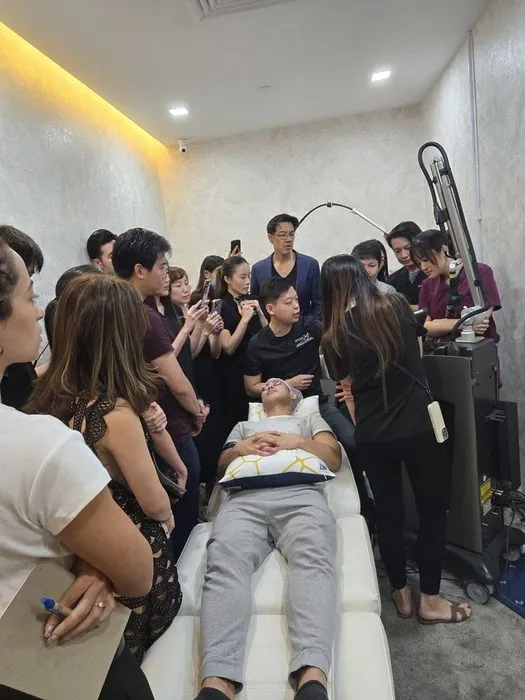
Demonstrating laser technique to visiting physicians — DEKA Tetra Pro training
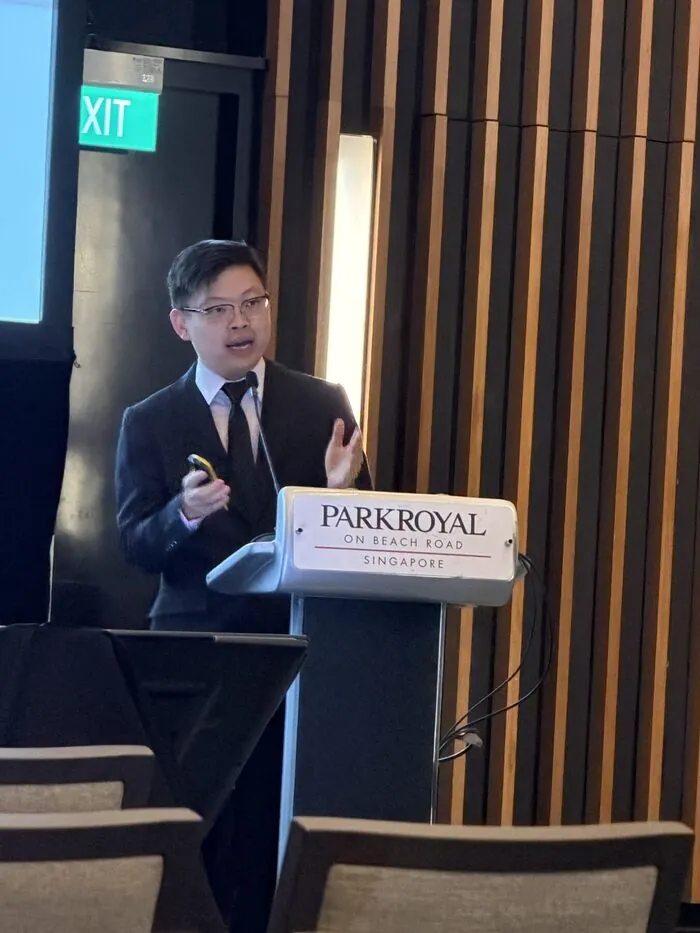
Conference speaker — SAM Conference 2026, Singapore
DEKA certification — CO2 laser platforms
DEKA certification — advanced CO2 laser platforms

“Do not fill a face that has fallen. Lift the fat back up first — then see how little filler you actually need.”

— Dr Sin Yong

Who it suits, who should wait, who is referred on

Tends to suit

  • Hollow cheeks that soften when lying back, suggesting descent
  • Hollows in the temples or cheeks that persist in every position
  • A gaunt look after weight loss or illness, once the cause is understood
  • Acceptance that change develops gradually and in stages

Better to wait

  • Pregnancy or breastfeeding
  • Active skin infection or inflammation in the area
  • Goals that need a surgical result, which are discussed honestly first

Referred on

  • Severe volume deficit or heavy laxity → plastic surgery assessment for fat grafting or lifting
  • Suspected medical cause of rapid facial weight loss → medical review first
Who should not have this treatment
  • Pregnancy or breastfeeding
  • Active infection, cold sore or open skin lesion in the treatment area
  • Implanted electronic device, such as a pacemaker, where radiofrequency is planned
  • Known allergy to filler or anaesthetic ingredients
  • Bleeding disorder or blood-thinning medicine, which needs review before injections
  • Previous filler of unknown type in the same area

People hoping for the tightness or shape change of a surgical lift tend to respond poorly, because heavy laxity or major deficit is surgical territory.

What happens, step by step

  1. Consultation and examination, upright and reclined, compartment by compartment
  2. Written plan and quote, mapped to the cause rather than the complaint
  3. Treatment day: lift first where fat has descended, then replace only the confirmed deficit
  4. Review and adjustment, with the maintenance interval agreed at consultation

Risks, side effects and when to call

Expected effects after radiofrequency or laser lifting include temporary redness, warmth and mild swelling. After filler, bruising, tenderness and swelling are common and settle on their own. Less common complications include lumps, asymmetry, skin irritation, infection, blistering or burns from energy devices, and pigment change. Filler can also block or compress a blood vessel, which is an emergency. These risks are reduced by finding the cause first, placing product by compartment, choosing reversible hyaluronic acid where it suits, and following aftercare. Results develop gradually and vary between people, and review timing is set at consultation.

Contact the clinic the same day if
  • Severe or increasing pain in the treated area
  • Skin turning white, grey, blotchy or dusky
  • Any change in vision or a sudden headache
  • Spreading redness, heat, blistering or fever
  • A hard lump or marked asymmetry that does not settle

See what to do if something feels wrong after a treatment.

Aftercare

First 24 hours

  • Avoid pressing, rubbing or massaging the treated area unless advised
  • Keep the skin clean and avoid heavy exercise, alcohol, sauna and steam as advised
  • Use a cool compress for tenderness or swelling if the clinic recommends it

First week

  • Expect mild swelling or tenderness and avoid facials or other energy treatments on the area until cleared
  • Note any lumps or asymmetry and mention them at review
  • Sleep with the head slightly raised if swelling is present

Sun

  • Apply broad-spectrum sunscreen daily and avoid strong sun and heat on the treated area

Skincare

  • Use a gentle cleanser and plain moisturiser
  • Pause retinoids and exfoliating acids until the clinic says to restart

When to call

  • Severe or increasing pain, skin turning white, grey or dusky, or any vision change: call the clinic straight away
  • Spreading redness, heat, blistering, fever or a lump that does not settle

Before you book

What determines the fee

The fee for sunken face treatment depends on the cause found at assessment, the areas involved (cheeks, temples, under-eyes or jawline), and whether lifting, volume replacement or both are needed. It also reflects the device or product used, the number of zones and passes, and whether treatments are combined. A written quote is given at consultation, after Dr Sin Yong has examined you. The consultation also decides whether treatment is advised at all, including the option of monitoring only.

How quotes work at this practice: how we quote.

Myths we hear in clinic

“Sunken cheeks always need cheek filler.”

Many sunken-looking cheeks are full compartments that have slid downwards, and filler placed into them can add weight rather than lift.

“Lifting and filling do the same job.”

Lifting repositions fat that has descended, while filler only replaces missing volume, so using one for the other's task tends to disappoint.

Frequently Asked Questions — Sunken Face Treatment

Three things, usually in combination. True loss of facial volume — fat atrophy from ageing, significant weight loss or medication. Descent — the facial fat compartments are still full but have slid downwards off the cheekbone. And bone resorption — the facial skeleton itself withdraws with age, removing the shelf the soft tissue sits on. The loss of facial volume causes in each face are mapped at assessment, because the treatment differs for each.

In most cases, yes. Descent is lifted with the VF Lift — monopolar radiofrequency applied along vertical vectors to reposition the fats upwards — and Time Freeze laser lifting, which tightens the collagen support they sit on. True volume deficit is replaced with dermal fillers or collagen biostimulators. No incisions, no general anaesthesia. Where the deficit or laxity is beyond non-surgical range, you will be told so honestly and referred.

A simple clue: lie down in front of a mirror. If the hollow softens or disappears when you recline, the volume is still there — it has descended, and lifting is the logical first step. If the hollow persists in every position, the compartment is genuinely empty and volume replacement is indicated. The formal assessment examines you both ways, compartment by compartment.

No — and this is the most common surprise at consultation. Many patients searching for cheek filler in Singapore have full fat compartments that have slid downwards. Filling on top of descent adds weight to tissue that is already sliding. Lifting first often returns much of the volume to where it belongs, and any face filler that follows is smaller and placed more precisely.

The VF Lift applies Volnewmer monopolar radiofrequency along vertical vectors, customised for face and body. The energy contracts and remodels the connective-tissue layers that hold the facial fat compartments, drawing the descended tissue upwards and tightening its support — a vertical lifting vector, without cutting. The effect builds over the following weeks as collagen remodels.

Time Freeze is laser collagen lifting — it stimulates the dermal collagen framework so the skin envelope tightens over the repositioned fat. It suits early laxity, faces that are beginning to slide rather than empty out, and maintenance after a VF Lift. For a sunken face it is one of the lifting tools, chosen when the assessment shows laxity is part of the picture.

Hyaluronic-acid fillers for adjustable, dissolvable volume; Radiesse and Ellanse where firmer structural support or collagen stimulation is wanted — including as a collagen filler for the face at the bone, where resorption has withdrawn support. The choice follows the compartment being treated, and every face filler injection plan is confirmed with you before anything is done.

Sunken eyes — hollowing of the tear trough and upper orbit — usually can be improved, but the approach depends on the cause. Where the midface has descended, lifting the cheek restores support under the eye. Where there is a true deficit, tear trough and cheek filler are planned together, because the tear trough is rarely an isolated problem. Sunken eyes treatment that ignores the cheek beneath tends to disappoint, which is why the two are assessed as one unit.

Yes. Rapid or significant weight loss — including with weight-loss medication — deflates the facial fat compartments faster than the skin can retract, producing a gaunt face with hollow cheeks and temples. Treatment usually combines lifting for the loosened envelope with staged volume replacement for the genuine deficit, planned conservatively so the face keeps its natural proportions.

The lift-first approach naturally moves the face towards a firmer, more tapered lower contour, because repositioning the midface fat upwards lightens the jowl area. Where a v shape face filler plan is appropriate — chin and jawline definition — it is added only after the lift, so the shape comes from structure rather than volume stacked on volume.

Filler volume is visible at placement and settles over days. Energy-based lifting works on a different clock: collagen contracts at treatment, then remodels over roughly 8–12 weeks, so the repositioning matures progressively. That timing is why the filler decision is finalised after the lift has developed, not before.

It depends on what your assessment finds — a face that needs lifting alone is priced differently from one that needs staged facial volume restoration in Singapore across several compartments. The plan and its cost are quoted individually at consultation, and always confirmed with you before anything is done.

Singapore's medical advertising rules restrict outcome photography online. Actual case photographs can be viewed in person during consultation at the clinic, where they can be discussed in proper clinical context.

It tends to suit people whose hollowing has a clear, treatable cause, such as descended fat or a persistent volume deficit, and who accept gradual change. It is less suitable for anyone expecting a change in face shape that only surgery can give, or whose mild, stable hollowing is better simply monitored. The assessment decides which group you are in.
It depends on the cause, the treatment chosen, your age, weight changes, sun exposure and how your face continues to age. Collagen-based lifting develops progressively and is reviewed as it matures, while filler is gradually absorbed at a rate that differs between people. No duration is promised; review timing and the maintenance interval are set at consultation.
Change is gradual, so patience is needed, and more than one type of treatment may be combined. Filler can cause bruising, swelling, lumps or asymmetry, and very uncommonly blocks a blood vessel. Energy devices can cause temporary redness or swelling. Heavy laxity or major volume deficit may need a surgical opinion, and reviews are needed to keep the plan matched to your face.

Question not answered here? Ask on WhatsApp, use the enquiry form, or browse 100 questions patients ask.

References

  1. Rohrich RJ, Pessa JE. The fat compartments of the face: anatomy and clinical implications for cosmetic surgery. Plast Reconstr Surg. 2007;119(7):2219-2227. PubMed
  2. Mendelson B, Wong CH. Changes in the facial skeleton with aging: implications and clinical applications in facial rejuvenation. Aesthetic Plast Surg. 2012;36(4):753-760. PubMed
SY
Dr Sin Yong
MBBS (NUS, Singapore) · MRCS (Royal College of Surgeons, Edinburgh)
MSc Practical Dermatology (University of Cardiff, UK) · MSc Aesthetic Medicine with Distinction (Queen Mary University of London)
Graduate Diploma in Sports Medicine (Nanyang Technological University)
International Key Opinion Leader — CLASSYS | HIRONIC | DEKA | ALMA | FOTONA | LUTRONIC
Pioneered Protocols Time Freeze Laser LCLR® · VF Lift · RVR ProLift · S3 Resurfacing · FSX Laser · 4K Body Lift · G Lift · Luminescence Laser

Sunken face treatment in Singapore at Dr Sin Yong's practice always begins with a structured facial assessment that separates the three causes of a sunken, gaunt face — true loss of facial volume, downward descent of the facial fat compartments, and age-related bone resorption. Descent is treated by repositioning the fats upwards with the VF Lift and Time Freeze laser lifting; genuine volume deficit is replaced with dermal fillers or collagen biostimulators; and many faces need far less filler once lifted. This information is educational and is not a substitute for a medical consultation.

Medically reviewed by Dr Sin Yong, MBBS (NUS), MRCS (Edinburgh) · Last updated 14 September 2026 · Editorial policy

Related reading
Where Dr Sin Yong consults: Wheelock Place, 501 Orchard Road, Singapore 238880 (unit on booking) · Orchard MRT · Mon–Fri 10am–8pm, Sat 11am–3pm · WhatsApp +65 8023 7170 · Getting here · How fees are quoted

Sunken Face Assessment — Dr Sin Yong

Assessment-first treatment of the sunken face — descent lifted upwards, true volume loss replaced, and honest advice on which yours is.

  1. 1WhatsApp a short note on your concern
  2. 2Consultation and assessment with Dr Sin Yong
  3. 3Options explained, including no treatment

Replies within clinic hours: Mon–Fri 10am–8pm, Sat 11am–3pm · How consultations work · Prefer not to use WhatsApp? · Treatment finder

WhatsApp Dr Sin Yong
Explore Further

Prefer Not to Use WhatsApp?

Leave your name, mobile number and email and the clinic will contact you directly. No obligation.

Your details are delivered directly to Dr Sin Yong's clinic team.

Thank you — your enquiry has been received. The clinic will contact you during opening hours (Mon–Fri 10am–8pm, Sat 11am–3pm).
Or continue on WhatsApp instead →

References

  1. Rohrich RJ, Pessa JE. The fat compartments of the face: anatomy and clinical implications for cosmetic surgery. — Plastic and Reconstructive Surgery, 2007.
  2. Mendelson B, Wong CH. Changes in the facial skeleton with aging: implications and clinical applications in facial rejuvenation. — Aesthetic Plastic Surgery, 2012.
Follow Dr Sin Yong
InstagramTikTokYouTubeThreadsXLinkedInFacebook
Dr Sin Yong · Every treatment personally performed
WhatsApp Enquiry