Published 20 September 2026 · Reviewed by Dr Sin Yong
Milia — 'milia seeds' in Singapore usage — are those firm, pearl-white bumps that sit for months around the eyes and cheeks, indifferent to every scrub, every extraction attempt, every promise on a jar. The reason they ignore your efforts is structural: a milium is a tiny sealed cyst of keratin with no opening to the surface. Understanding that one fact explains both why squeezing fails and why clinic removal takes seconds.
A milium has no pore — removal creates a precise opening first, which is why home squeezing fails.
Key facts
Milium
A 1–2 mm superficial cyst of keratin (the protein of the skin's surface layer) trapped beneath intact epidermis
No punctum
Unlike a comedone, a milium has no opening to the surface — nothing connects it to the outside
Primary milia
Arise spontaneously, most often around the eyes and cheeks, at any age including newborns
Secondary milia
Form during healing after blistering, resurfacing procedures, burns or prolonged steroid creams
Keratin
The structural protein of the epidermis — milia are keratin pearls, not trapped oil
Extraction
A sterile needle-point opening followed by expression of the pearl — seconds per lesion
Eye-area caution
Thin periocular skin makes home instruments particularly risky near the eyes
What a milium actually is
A milium is a miniature cyst: a pearl of compacted keratin sealed under an intact roof of epidermis. It is not a whitehead, not trapped sebum, and not a sign of poor cleansing. The classification by Berk and Bayliss separates primary milia — arising spontaneously in perfectly healthy skin, most often periocular — from secondary milia, which form as skin heals after blisters, abrasions, resurfacing lasers or long courses of potent steroid creams. Both are harmless; both are stubborn for the same architectural reason.
Why squeezing fails — and often backfires
A comedone has an exit; a milium does not. Squeezing a lesion with no opening simply drives pressure into the surrounding dermis — the pearl stays, the skin around it bruises and inflames, and in Asian skin that inflammation frequently deposits a brown mark that outlasts the milium by months. Home needling adds infection and scarring to the menu, and the periocular location of most milia means people are doing this millimetres from the eyelid margin. The lesion is trivial; the home surgery is not.
“A milium has no exit. Squeezing it punishes the skin around a pearl that was never going anywhere.”
Dr Sin YongOn why home extraction fails
What actually causes them
Primary milia are essentially a quirk of skin turnover — retention of keratin within a tiny follicular structure — with a strong preference for the thin skin around the eyes. Secondary milia follow a disruption: they are famous after ablative resurfacing, after blistering injuries, and under occlusive products in some skins. Heavy, waxy eye creams are a soft contributor in milia-prone individuals — not a cause in everyone, but worth auditing if you grow crops of them. What they are not is a hygiene problem, and scrubbing at them accomplishes nothing but irritation.
How clinic removal works
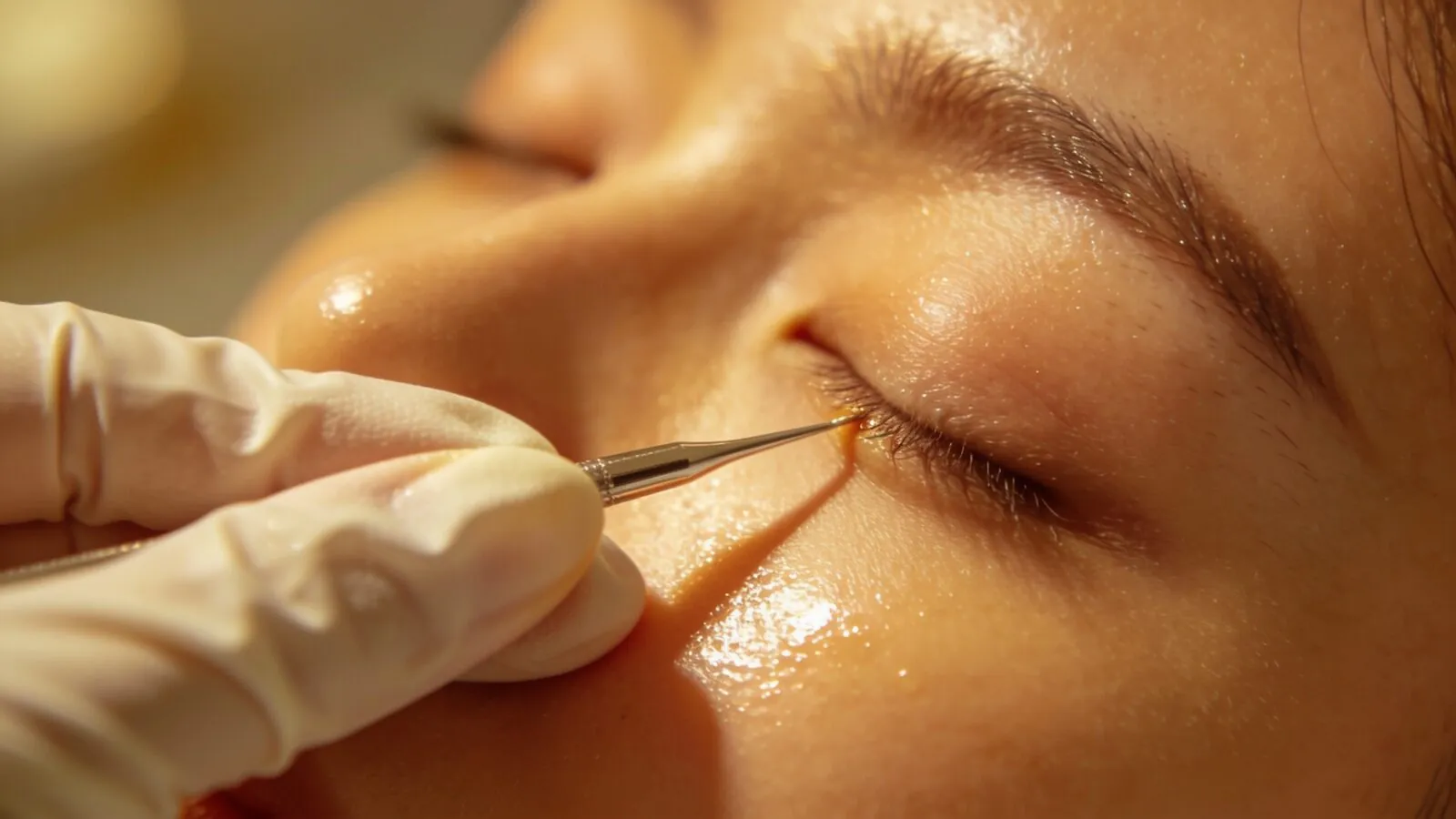
Extraction is quick and slightly anticlimactic: the surface is prepared, a sterile fine point creates a precise opening in the roof, and the keratin pearl is expressed whole with gentle pressure. Seconds per lesion, a pinpoint mark that settles in days, and no sutures. Numerous or recurrent milia can alternatively be ablated with fine radiofrequency or laser tips. En plaque or eruptive patterns — sheets of milia — are uncommon and earn a proper dermatological assessment rather than serial extraction.
Keeping them from coming back
Prone skins re-form milia, so maintenance is about tilting turnover in your favour: lighter textures around the eyes if you are occlusion-sensitive, retinoid-based skincare where tolerated to keep keratin moving, and sun protection because photodamaged skin retains keratin more readily. After resurfacing procedures, transient milia are common and simply extracted at review. None of this is a cure for the tendency — it is management of a harmless quirk, honestly framed.
Milia seeds or something else? Other white bumps that look similar
Not every small white bump is a milium, and the difference changes the treatment. Milia are pearl-white, firm, about the size of a pinhead, and have no visible opening; they sit most often around the eyes and on the cheeks.
Illustrative image — not a patient.
Closed comedones, or whiteheads, are softer, flesh-toned to white, and tend to cluster on the forehead, chin and T-zone in oily or acne-prone skin; they are blocked pores and are managed as acne. Syringomas are small skin-coloured bumps, usually clustered symmetrically under both eyes, arising from sweat-duct tissue rather than keratin, so extraction does not clear them. Xanthelasma forms soft yellowish plaques on the eyelids and is linked to blood lipids, which may be worth checking. Sebaceous hyperplasia appears as yellowish bumps with a tiny central dip, usually on the forehead and cheeks in adulthood.
Because these look alike to the untrained eye, Dr Sin Yong confirms what each bump is before treating it. A syringoma mistaken for milia and picked at simply becomes inflamed, while a true milium is cleared in seconds once its roof is opened correctly.
How is milia seed extraction done near the eyes?
Milia seed extraction near the eyes follows the same principle as anywhere else, opening the roof and expressing the pearl, but with more care because periocular skin is among the thinnest on the body. The skin is cleansed, the area is well lit and magnified, and a sterile fine point is angled along the skin surface rather than towards the eye.
Only the thin roof over the milium is opened, which is why the procedure is quick and usually leaves no more than a pinpoint mark. Gentle pressure from the sides then delivers the keratin pearl whole. If a lesion is deeper or does not express cleanly, it is left rather than forced, and may be treated with a fine energy tip instead.
Afterwards, mild redness at each site usually settles within a day or so, and an occasional tiny bruise can appear on the thin lower lid. The sites are kept clean and not rubbed, eye make-up should be kept away from them until they have closed, and heavy, occlusive eye creams are worth reviewing if you are prone to new milia.
Milia seed removal options compared by what each can and cannot do
Option
What it does
What it cannot do
Typical recovery
Who it tends to suit
Sterile de-roofing and extraction
A sterile fine point opens the roof of the cyst and the keratin pearl is expressed whole
Does not change the skin's tendency to form new milia
A pinpoint mark that settles in days
Individual milia around the eyes, cheeks and nose
Fine radiofrequency or cautery tip
Ablates the milium with a fine energy tip and seals the site
Not needed for a few isolated milia that extract easily
A tiny crust per site
Numerous or recurrent milia
Laser ablation
Vaporises the roof and contents precisely with depth control
Leaves no tissue for examination, so the diagnosis must be clear first
A small crust per site; sun protection while healing
Recurrent milia, or milia in areas where precision matters
Retinoid-based skincare
Keeps keratin turning over to reduce the formation of new milia
Rarely clears established milia on its own, and can irritate thin skin around the eyes
Possible dryness or irritation while the skin adjusts
Milia-prone skin, as maintenance after extraction
Dermatological assessment (referred on)
Investigates widespread or unusual patterns such as eruptive milia or milia en plaque
Serial extraction alone does not address the underlying pattern
Depends on the cause found
Sheets or sudden crops of milia rather than a few scattered lesions
Home squeezing or needling
Pressure or a non-sterile needle applied to a lesion with no opening
Cannot express a sealed cyst reliably, and risks infection near the eye
Bruising, inflammation and brown marks that can outlast the milium
Not recommended
Milia Seeds — Frequently Asked Questions
Tiny superficial cysts of keratin — the skin's surface protein — sealed under intact skin, usually 1–2 mm, white and firm, most often around the eyes and cheeks. 'Milia seeds' is the common Singapore term; medically they are simply milia.
Because unlike a pimple or blackhead, a milium has no opening to the surface. Pressure has nowhere to push the contents, so squeezing only traumatises the surrounding skin — often leaving a brown mark that lasts far longer than the milium would have.
A sterile fine point creates a tiny opening in the roof of the cyst and the keratin pearl is expressed — seconds per lesion, no sutures, minimal marks. Several lesions can often be treated at the same visit.
The periocular skin is thin and rich in fine follicular structures where keratin can be retained — it is the classic site for primary milia. Heavy occlusive eye products can contribute in prone individuals, but most periocular milia arise in perfectly well-cared-for skin.
Some do, over months; many persist stubbornly. Newborn milia resolve on their own within weeks. In adults, a milium that has sat unchanged for months is unlikely to leave without extraction — and equally unlikely to cause any harm while it stays.
No. Milia are a quirk of keratin retention, not blocked dirt or oil. Scrubbing does not prevent them and often irritates the thin skin where they live.
Fine radiofrequency or laser tips can ablate milia precisely, and are useful for numerous or recurrent lesions. Standard facials cannot — an extraction facial can express open comedones, but a sealed milium still needs its roof opened first, which is a medical step.
Secondary milia are a recognised, temporary feature of healing after ablative procedures — regenerating skin briefly traps keratin as it re-forms its layers. They are extracted easily at review and do not indicate anything went wrong.
Retinoids help keep keratin moving through the skin, so they are useful for reducing new milia in prone skin. They rarely clear an established milium that has sat unchanged for months, because the pearl is sealed under the surface. Prescription-strength tretinoin and other retinoids can irritate the thin skin around the eyes, so how and where to use them should be discussed with a doctor.
A correctly performed extraction opens only the thin roof of the cyst, so it usually leaves a pinpoint mark that settles within days. Marks and scarring are much more often the result of repeated squeezing or picking at home, which bruises and inflames the surrounding skin. In Asian skin, sun protection while the sites heal helps prevent brown marks.
Berk DR, Bayliss SJ. Milia: a review and classification. J Am Acad Dermatol 2008;59(6):1050–1063. source
Explore Further
Milia seed removal is a minor clinic procedure. Each milium is a sealed pearl of keratin with no opening, so a sterile fine point first makes a tiny opening in its roof and the pearl is then expressed whole. Numerous or recurrent milia can instead be ablated with fine radiofrequency or laser tips. Squeezing at home cannot clear them.